Showing posts with label film. Show all posts

Tuesday, February 26, 2008

Christina Ricci's Seven Year Cycles


The girl who epitomized the attraction to apathy in the '90s is no longer "going to hide behind her notorious sarcasm," according to New York Magazine, who profiles Ms. Ricci as she gets down into some unexpected fatalism:
Christina Ricci is a fervent believer in seven-year cycles. “My mom told me, ‘Every seven years, everything changes: your physical being, your emotional being, the way other people look at you. Everything’ … Oh, God,” she moans, mocking herself. “This is the kind of shit—if I go into the bookstore and ask for the astrology section, they’re always like, ‘Oh, a.k.a. the crazy-lady section?’ That’s where you’ll find me. Yep, the crazy-lady section.”
Ooh yeah. All sarcasm gone it seems.

Tuesday, February 19, 2008

Mac Fetish

Since its inception in 1984, the Macintosh has garnered a cult status to the point of fetish. The doco MacHEAD seeks why.

Saturday, February 16, 2008

Madonna's Filth & Wisdom

Filth and Wisdom, which just premiered at the Berlinale, is Madonna’s directorial debut. Finally taking it from behind… the camera, the Queen of Pop tackles a subject close to her heart and most easily supplied by her own boudoir: stripping. Let’s hope that hubby filmmaker Guy Ritchie (Snatch and the unfortunately unforgettable Swept Away) stayed away for the sake of the film’s watchability.

Here’s a three-minute short thanks to IndieWire.

Monday, February 4, 2008

Hollywood: Too Much Handheld, Not Enough Grip

Kyle Smith, film critic to the New York Post recently wrote an article, “Handheld Cameras Are Officially Over,” partly in response to the lukewarm reception of Cloverfield, J.J. Abrams’ latest soon-to-be forgotten marketing masterpiece, shot entirely with the effect of a shaky handheld camera.


A lot of people cite The Blair Witch Project - equally forgettable - as the beginning of cinema’s obsession with the shaky-cam, but I remember the first big-budget foray one year earlier with Stephen Spielberg’s Saving Private Ryan, particularly in the infamous Omaha Beach landing scene.


Spielberg commercialized the fly-on-the-wall style of cinema vérité, replacing the fly with Tom Hanks and the wall with a legion of German mortars, giving to the war genre the effect of gritty realism and first-person presence.

Private Ryan’s shooting style foreshadowed the onslaught of Fox News’ own gritty and realistic war coverage as journalists reported from their “embedded” infantries in between gun-battles and car-bombings. Through overexposure, the shaky-cam has entered our visual lexicon and has come to be equated with veracity, courage and truthfulness uncontrived.

The Mancurian author Anthony Burgess labeled America’s demand to “face up to reality” as Nixonian; that is, a nation led by the lying smile of a president thug and fed on the monochromatic bloody images of the Vietnam War is a nation with a predilection for suffering.

On a hesitantly zooming lens, we watched the reality of a Boeing-767 marrying metal-to-metal as it collided into Tower Two of the World Trade Center. Camera phones provided the first glimpses of the 2005 London bombings. All over South East Asia reporters-for-the-day emailed and SMSed anxious holiday footage of a 30-metre wave.

Indeed, the world has become Nixonian. Through images, we deal with the harsh and visceral truth of all things. We have a propensity towards the real, so much so, that all images become a function of the real, particularly those steeped in fiction. We say the computer-generated images of the latest action blockbuster are “so real”. J.J. Abrams goes so far as to produce those effects in the lens of a handy-cam, as if we might be able to recall the images of 9/11 as mere phantasmagorias, conjured up by some studio lot in Burbank.

Perhaps a detriment to Cloverfield, is that for all the reality it professes - heightened by the promotional image of a battered Statue of Liberty (no doubt exploiting the visual unconscious of all New York’s observers) – it treads too close to what Jean Baudrillard referred to as the “hyperreal”, a reality exploited to the point of nonsense. Hollywood dreams of a reality so real, it ceases to be real, or as another post-modern theorist put it, we exist in the “desert of the real.”

Compare the action sequences in Private Ryan and Cloverfield with the impossibly smooth and flowing images of Alfonso Cuarón’s Children of Men.


In Children of Men D.O.P. Emmanuel Lubezki also utilizes a handheld approach, giving the appearance of documentary. Almost every scene is contained in a single tracking shot, but a single cut where the camera moves seamlessly and unshaken within a chaotic environment. There is an ethereal dream-like quality as the camera pans and follows the protagonist, seeing what he sees and observing what he observes.

Now watch this seminal scene from Stanley Kubrick’s 1957 masterpiece Paths of Glory.


A reverent irreverence or solemn nonchalance characterizes this style. The camera reflects the humorless demeanor of our protagonists as he walks pensively down the trench. Unlike in Saving Private Ryan, it reflects contemplation, not action.

Reality (and I mean hyperreality) stupefies the viewer into shock, causing him or her to reject the experience, alienating one from any deeper understanding. The difference between gritty realism and the ethereal dream is the difference between suffering and contemplation. We contemplate the dream. We attempt dream interpretation.

With hyperreality, we are lost in the moment, lost to the emotive purge: fear, love, dread… we risk seeing reality taken to such a horrifying extreme, that we lapse into apathy: “this is just the way things are.” Or, we go into shellshock and deny the world’s malevolence altogether and simply await Tom Hanks to come pick us up and bring us into the third act.

Perhaps audiences are becoming jaded with hyperreality. In our current wartime, we are constantly bombarded by images on our TVs and in the cinemas dictating to us the veracity of reality. What filmmakers such as Cuarón and Lubezki are doing - and others including Joe Wright, Todd Haynes and Julian Schnabel - is recalling the contemplative and inspirational styles of Fellini, Kubrick and Hitchcock, where dreams have as much validity as reality does.

Wednesday, January 30, 2008

Blanchett’s Yiddish Bone: “what does that even meeean, maan?”


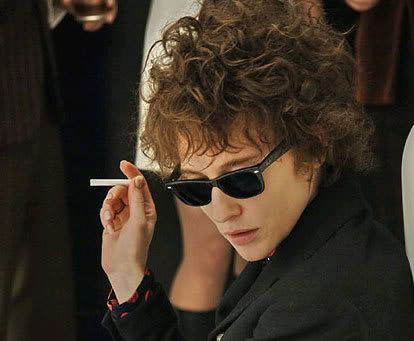
Personal note: Never have I remotely been attracted to the waifish and slightly Jewish appearance of Bob Dylan, yet embodied by the scrawny and slightly taller figure of Cate Blanchett, oh boy I want to jump his Yiddish bones!

Todd Haynes’s allegorical film I’m Not There is a parade of Dylan. Five Dylans in fact, personified by five distinct actors; none of who, in the flesh, remotely resemble the iconoclastic singer-songwriter. However, it is Blanchett’s eponymous performance as the post-folk, post-acoustic, post-political, post-Christian Bale and dare I say, post-Dylan Bob Dylan that eats Queen Lizzie’s cake, as evidenced by her recent Golden Globe win and Oscar nods.

Floating through a whimsical landscape patched together from interviews, live performances and well-known anecdotes, Blanchett channels the ghost of a man who simply is not. From press conference to performance to garden party, he, she, they… stammer dyslexically through their meaningful meaninglessness with lyrical acumen: “Two words on Shakespeare…Raving queen. Cosmic amphetamine brain. I dig Shakespeare.”

He is a performer, a “trapeeeze R-tist”, a caricature of existential bad faith and a poster-child for the post-modern identity: neither present nor absent, active nor passive, man nor woman. And who better to portray such a conundrum of personality than one who has shared sheets with the likes of Queen Lizzie (Elizabeth) and Cat Hepburn (The Aviator)?

Throughout his career, Dylan’s consistence in defying and defiling the media’s claim on him is a testament to his self-reflexive infidelity. He is a liar, a sinner, an asexual deviant, who for years, has been sleeping with the other halves of himself (“God, I’m glad I’m not mee”); and so the time has come for Blanchett to loan her body to an ephemeral orgy with the ghosts of Bob Dylan.

Ephemeral, for whatever photographs, sound bites and archived film reels are splayed out for the sake of defining the man behind the music (Blanchett’s act is partially based on D. A. Pennebaker’s fly-on-the-wall documentary Don’t Look Back), he vanishes, to be replaced, somewhere between the fifth and third acts by Richard Gere. Simply, he is not there. Bob Dylan is not present. He is yonder, at the vanishing point of the horizon, outside the screen’s frame, watching from the projection room with a doped-out grinning Allen Ginsburg wondering, “what does that even meeean, maan?”

And so where Dylan is not, Blanchett will be. Where Dylan disintegrates into the tomes of music journalism and cinema vérité, Blanchett is present with harmonica and cigarette; that is, to nail down, for a fleeting second, the smoke-filled spectre of a man not there.

The enigmatic Blanchett outperforms Dylan’s phantom. He is annihilated leaving a post-Dylanism, leaving in his wake a corpus, a body of work, a body that matters; that is, Blanchett’s body. And logically, this body must reinterpret the cinematic oeuvre and embody all of histories curly-haired paragons: Cate Blanchett as Bob Dylan as Queen Elizabeth, Cate Blanchett as Bob Dylan as Catherine Hepburn, Cate Blanchett as Bob Dylan as Captain Jack Sparrow. But why stop at the world of celluloid? Imagine a political revolution of Blanchett: Cate Blanchett as Bob Dylan as Barack Obama as President of the United States. For in the performance of all things, if gender is an illusion, surely then, race is too.

For who can deny the power of the Blanchett? She is a performer to outperform all others, to outperform the very idea of performance. She unveils the very lie that is identity and that indeed we are all sleeping with our other halves. “Sleep? Sleep is for dreeamers, maan,” and what a dream it is, because in the post-Dylan, Blanchett discloses to us all, that really, at the end of the day, we are Bob Dylan.

And so the logical question transpires? In the coming post-Blanchett era, who will play Blanchett who plays Bob Dylan who plays no one but himself who isn’t there in the bio-pic about Blanchett who plays Bob Dylan in I’m Not There?

The answer, of course, is you, because “you’re liiaars, all of you.”